Sunday, May 31, 2015

take two

 He was fighting a losing battle against cancer and was receiving experimental chemotherapy.   His spouse demanded everything be done to keep him alive.  “He’s too young to die, we have small children,” she sobbed. I suggested making him DNAR, do not attempt to resuscitate, and she became angry. 
“Boston  tells us the chemotherapy might work, and if you make him a no-code, you have extinguished any hope we might have.”
The Hospital called.  He was failing. He was on pressors, intravenous medicines used to maintain blood pressure at times of crisis.
“I’ll come right down, “ I said. I would speak to the spouse, discuss the perils of being a patient with advanced cancer who underwent cardiopulmonary resuscitation.
By the time I arrived at the intensive care unit, he was gone. He lay on a gurney, eyelids open,  eyes bulging from their sockets from the 30 minute-long  attempt to retrieve him.  His expression was one of abject terror.
His arms were swollen and bleeding, stigmata from multiple attempts to insert 18 gauge needles as he lay dying. I beheld a scene of un imaginable violence.  

  My patients with advanced disease who undergo in-house  CPR share  a common fate. They all die alone, without family in attendance.  When CPR begins, the family is hustled out, useless civilians driven from a battlefield, an alien arena in which they are useless.Worse, their weeping and attempts to comfort their loved ones makes resuscitation hazardous for patient and family members alike.  One cannot  embrace a loved one receiving  a 360 joule electro conversion shock. 
                     I am wary of buildings bearing messages, Work Makes One Free, Ignorance is Strength, but the portal to every Medical school and hospital should bear the warning:
  Death is not the enemy, Suffering is.

Modern medicine has forgotten this simple truth, at our own peril.
             I have taken to making house calls.  Some patients are bed bound, so I throw my stethoscope in the Honda, don a white lab coat and drive Connecticut streets, seeking my wayward patients.
            The results have been startling.
            I enter a house. The patient lies in the living room, in a hospital bed, dying.
In our storied past, loved ones died of old age.  Once upon a time, we died at home.   We died upstairs in the master bedroom, covered in a hand -made quilt as family members said goodbye, reminisced, shared the vigil against encroaching night.
Nowadays, no one dies of old age.  The term itself has become vaguely grotesque, politically incorrect, and pessimistic. Patients die of atypical tuberculosis, protein wasting syndrome and immunodeficiencies, By giving name to these conditions, we imply that treatment, and hence salvation, exists.
 I blame Dylan Thomas.  We have taken his admonition to rage against the dying of the light to heart
Family members approach me. “ What did Boston tell you?”   Boston, medical Mecca, has become shorthand for,   "the place where my loved one will receive a lifesaving diagnosis and treatment.”
           
I blame ourselves as medical providers. We sometimes encourage futile therapy, claiming to restore hope but forgetting that  the new proposed therapy has the  slimmest chance of success, at the  expense of additional suffering for patient and family.
Insurance companies’ policy rates are skyrocketing.  I am not excusing their behavior but rates increase when we decide as a culture that a brain MRI or 30 minutes of a cardiopulmonary code would be more therapeutic than soft classic music in an upstairs bedroom where the lights are low and the air smells of lavender lotion. 
To be fair, we are staring to recognize that a patients’ death is not necessarily an indication of our failure.. We now use the phrase: Do not Attempt to resuscitate, rather than Do Not Resuscitate.   This subtle shift suggests there is no magical procedure to return our loved one from the banks of the River Styx.    We need to teach our medical students that every patient will eventually die, will eventually fail to respond to  any number of  expensive treatments and uncomfortable testing.
This raises the point: Is Cardiopulmonary Resuscitation ever useful, especially for  patients with cancer?
The answer lies in a patients’ health prior to  CPR.  If an otherwise healthy patient with cancer ( or without cancer, for that matter)  suffers  a cardiac arrest,  CPR offers a reasonable chance the patient will leave the hospital alive. For debilitated cancer patients (defined as those who spend at least 50% of the day in bed) a 2002  study pronounced   Hospital based CPR “ Futile.”
       I have been fighting  Chronic  Lymphocytic leukemia since 2007, and underwent  a stem cell transplant in 2011.   I wrote of my disease and the need for universal vaccinations in a 2011  New York Times op ed piece. I wrote that cancer taught me the value of community.  Cancer has now taught me that death is not the enemy, suffering is. I am in remission ( excuse me, Ptoo ptoo) but suffer  daily from Graft verses Host disease, an insidious  syndrome in which my donor cells attack my own innocent tissue.  I have experienced days so  pain filled that I  wished I could end my suffering in any way possible.  I don’t mind dying, I dread suffering, especially without a reasonable expectation my misery will end.  I view CPR for the terminally ill as a form of needless misery.
       My patients are becoming more involved in their healthcare. They demand that I review their CT scans and blood work with them.  I see real irony here, but I also see a chance for improving health care delivery. My patients panic when their MCHC  (mean corpuscular hemoglobin concentration) is elevated. They want to know what that means, The honest answer is  “if you are not anemic,  an isolated abnormal MCHC doesn’t mean much.”   I wish they showed as much interest in their DNAR status. We ask our patients to sign DNAR papers which describes CPR in the mildest terms .  Our form reads, in part
        if you stop breathing would you allow a tube to be       inserted into your throat?
       These forms should be more honest and more accurate. They should read:
       The chance of survival  in any patient with any terminal disease who undergoes an insertion of a breathing tube and  the application of electrical shock to the chest is essentially zero. During this attempt at resuscitation, you may experience pain, anxiety and fear. If you require the insertion of a breathing tube, your family will be forced to leave the room and there is a possibly you will die in pain and without loved ones around.
       I contemplated requiring  all patients requesting “ full code status, no matter what” to watch a video  of a patient undergoing  CPR, but that would be too gruesome  to watch.  Viewing such a video could produce its own suffering.

        If I were hospitalized because my cancer had returned, I am certain I would request DNAR status .
       A Johns Hopkins study found 90% of all graduates from the Johns Hopkins school of Medicine would decline CPR unless they had an acute, treatable condition. We  physicians have  run or watched  too many attempts at cardiovascular  resuscitation  to want this procedure performed on us.

        When my time comes, I want to die in my bed,  the sound track of  Kiss me Kate  playing in the background, a generous dose of morphine and Ativan  soothing my central nervous system and the  healing scent of chicken soup wafting up from the kitchen. Wouldn't you?

Saturday, May 23, 2015

Death be not a stranger


Note:  Hartford Hospital’s legal department has warned me to state that the following article  does NOT pertain  to any specific person, all details are composites used for illustrative purposes only. So, back off.
            I am wary of buildings bearing messages, Work Makes One Free, Ignorance is Strength, but the portal to every Medical school should bear the warning:
            Death is not the enemy, Suffering is.
            Modern medicine has forgotten this simple truth, at our own peril.
             I have taken to making house calls.  Federal guidelines demand all patients discharged from hospitals be seen by a physician within 45 day of discharge. Some patients are bed bound, so I throw my stethoscope in the Honda, don a white lab coat. and drive Connecticut streets, seeking my wayward patients.
            The results have been startling.
            I enter a house. The patient lies in the living room, in a hospital bed, dying.
In our storied past, the loved one would be dying of old age.  Once upon a time, we died at home.   We died upstairs in the master bedroom,  covered in a hand -made quilt as a stream of family members  said goodbye,  reminisced, shared the vigil against encroaching night.
Nowadays,  no one dies of old age.  The term itself has become vaguely grotesque, mocking, and politically incorrect.
My 90 year olds  die of atypical  Tuberculosis, renal failure, immunodeficiency, but never of old age.
This distinction is problematic.
I blame Dylan Thomas.  We have taken his admonition  to rage against the dying of the light to heart.  Family members no longer visit to hold  hands, offer a sip of something cool and sweet, or to reminisce, often in the mother tongue, about life  in another land , another century.
            Family members approach me. “ What did Boston tell you?”   Boston, medical Mecca, has become shorthand for  “ the place where my  loved one will receive a lifesaving diagnosis and treatment.”
            Family members are angry “ The Boston doctors said that  chemo would save his life,” or “The doctors at the Farber think  this may be caused by an obscure  immunodeficiency.”
            Once upon a time,  people died of old age. Now they die of IgG4 deficiency syndrome.
No one wins in these situations.
Family members are angry about missed diagnoses, missed chances. “The Boston doctors told us if he received treatment, he would be OK.”
            To be fair, my colleagues on Longwood Avenue  usually don’t make  these bold statements. People hear what they want to hear, but this misses the point.
            My patients are dying because their time to die is nearing.  We do our patients a grave disservice by raging  against  inevitable mortality,  when we should be  holding a parents’ hand,  giving a loved one a chance to talk about life in  Russia or Poland or Hartford in the 1930s.
I read in today’s Times that  Insurance companies  are  raising their rates. I cannot condone their behavior, this isn’t problem in any  other first world country.  I suspect this is partially  because Europeans  treat death  not as an enemy, but as constant companion who will eventually point to his watch and say,  “Time’s up, come with me.” Rates go up when we decide as a culture that a  brain MRI would be more therapeutic than soft classic music in an upstaird bedroom where the lights are low and the air smells of lavender  lotion. 
            I am troubled  that we mask our fear of death  by our insistence on chasing medical miracles.   Sometimes, we should  concentrate on alleviating uncomfortable symptoms, not seeking panaceas.    I  talk to  family members  about  methods to control pain,  reduce anxiety, improve appetite, and treat insomnia.  These conversations are sometimes perceived as an admission of failure. Worse, my suggestion to  increase  a morphine dose is perceived as my confessing that I am a quack.  If I were really smart, I would  have devised an elegant scientific  plan to  prolong a patients life. My attempts to alleviate pain would not be considered a  ham–fisted attempt to  cover my tracks,  sending a misdiagnosed and mistreated loved one to the great beyond prematurely in an opium  tinted haze.
Medicine is too slow to adapt to the obvious but unfamiliar  concept that  physicians will eventually lose every battle against death.
            We once  used the phrase “DNR” meaning “Do not resuscitate. ” This  concept  carries a  dangerous conceit that there exists a  procedure that will bring a patient back to life.   DO NOT resuscitate suggests a rejection of  a life saving technique.
We now use the phrase : Do not Attempt to resuscitate.  This subtle shift suggests there is no magical procedure to return our loved one from the  banks of the River Styx.
            Death is the new sex.
            Once,  sex education wasn’t taught in schools.  The concept of procreating made us uncomfortable.  We were afraid our children would become obsessed,  irrational, and lascivious if they  learned about procreation and contraception.
            We don’t teach death Ed classes, the concept  sounds morbid, bizarre, Adams family -esque.
            The analogy is apt, When  the religious right preaches abstinence only programs, in essence, denying human sexuality,  the results is an uptick of STDs and pregnancies.
 Medical schools  teach of medicine's  miraculous healing powers.   Hospice education reeks  of failure.  “Palliative care, eh? What,  you couldn’t figure out what the patient was dying of?’ Is the  inherent message.
            We need to teach our medical students that every patient will eventually die,  will eventually  fail to respond to  any number of  expensive treatments and uncomfortable testing.
            The Roman gladiators  were once pursued by a companion who would intone,  ”Thou art  mortal Thou art  mortal” to remind the  athletes that  his  finely honed physique was  not immune to sword and sling shot, not to mention Dengue fever.  I want every medical student to be reminded daily  “Your patients are mortal,  every single one will die.”  Lenny Bruce once urged that we  utter racial epithets throughout the days., in this way he proposed, the hateful words would lose their sting  and therefore,
you could never make some six-year-old black kid cry because somebody called him  a  ****** at school.
Perhaps if we  told every patient  “You will die, you will die, you will die.”  the emotional wallop would fade and we could  concentrate on what is important:  comforting the sick and accepting their inevitable departure

Friday, May 8, 2015

Semi Charmed Kind of LIfe


You looking for a new internist?
I am taking new patients into my practice in Wethersfield, Connecticut.  Really.   Just call 860-696-2400 and ask for a new patient visit with Dr Weinreb.
            My story?   Let’s see…   Cum Laude from Cornell, Graduate  of SUNY upstate,  residency at Michael Reese, an old  University of Chicago teaching hospital  I  finished my Heme Onc  fellowship  at U Conn in 1993.  I won a  50,000 dollar cancer research grant in 1994. My  1998 paper  (1) is regarded as a seminal work in the then nascent and not-at-all-ironic field of allogeneic stem cell transplantation.
And then I contracted CLL and everything when to shit.  Excuse me.  Feces.
            One factor you need to know: Please don’t ask me  to refill your narcotics prescriptions.  Too close to home for me.
I know about addiction.  I know about pain.  I know about narcotics withdrawal
My experiences have given me unsettled sympathy for those of you who  haunt the internet, hoping the Philippines web site will  send you  Dilaudid. I understand those of  you who  appear at Emergency Rooms at odd hours,  apologizing to the sleepy  ER doc that you  forgot you pills,  please be a dear and refill my  Vicoden  I need  just a few… I won’t bother you again.

Doctor, please
Some More of These

It wasn’t long ago  I lay on our  cool, soothing bathroom  tiles , sobbing  because a  diamond -tipped drill bit  was shredding  the inside of my mouth.  I wasn’t working, I was too debilitated to get dressed.   I found perverted salvation in  Morphine sulfate, which   allowed me to sleep at night . I took prednisone and tincture of time. Eventually the  GVHD, the name given my  diamond-tipped demons, retreated.   At some point I decided it was time to stop the narcotics. I tapered the Morphine down low and  went cold turkey, as the  kids and junkies say.
 This was a mistake.
How can I describe narcotics withdrawal to you?   Describe orgasm to a 5 year old. I think of the tongue- tied Apollo astronauts struggling to describe the lunar surface .  “A dirty beach” was what they came up with.
Let me try.
            Think of the worst day imaginable. Think of your parents dying in pain, your spouse departing for the embrace of another. Think bankruptcy.  Now, subtract from this any fledging feeling of hope lingering in your heart.  Erase any thought that life might get better, ignore   the faint voice of self- preservation.  Believe in your heart that your parents will die every day, that bankruptcy will become a quotidian  occurrence,. Now, at the same time, imagine the worst flu of your life,  the sort where   Russian Babushkas   beat your body  with  brooms made of  ash wood branches
I was smugly told in medical school,   “don’t worry. No one every dies of narcotics withdrawal,”  as if that was its saving grace. The benefit of withdrawal’s  exquisite  agony is that one is too debilitated to buy a knife, climb a cliff or  fly an airplane into a mountain.

This exorcism continued for three weeks.  Finally, the spell was broken.
            Sometimes I think every healer, every doctor, nurse, pharmacist be required to  undergo  opiate withdrawal before receiving licensure.  They would understand that  withdrawal  is a unique  circle  of hell that can’t be described, only experienced.
 I understand why people become junkies, why they refuse to quit , why they spend their lives taking methadone.   I   understand the unique terror of withdrawal
Third Eye Blind got it right in the lyrics of Semi charmed kind of life, when they described meth addiction:
And you hold me, and we're broken
Still it's all that I wanna do, just a little now
Feel myself, heading off the ground
I'm scared, I'm not coming down
No, no
And I won't run for my life
She's got her jaws now, locked down in a smile
But nothing is alright, alright


( the  reference to  a “jaw locked down in a smile” : Meth addicts lose their teeth, but persist taking the drugs. Shudder)
So what do I do?  

For one. I tried to avoid talking new patients into my practice.
             I have to take new patients. It’s the rule. Actually, I don’t have to accept new patients.  The medical group has an exemption for those with ” chronic medical conditions.”   Even the disease CLL holds the word “ chronic” in it.
So, give me a break .Let me keep my panel closed. Let me minister to patients I already know.
I have to open my panel.  I don’t want to be that guy.

I don’t want to be the one-winged  gull , the  three legged cat, the  impaired physician.  I want  to set an example:  Cancer is not an exemption.   I laugh when patients ask for jury duty exemption.  “Doc, I have high blood pressure, and diabetes and I can’t sit in a jury. ’ I want to chuckle.  “ I’d  kill for only having high pressure and sugar. I have those minor issues and I’m dealing with cancer too . No exemption for you!”
            Some of the more observant of you might ask ,”isn’t your wife a big mucky muck in the organization?”
 To you I say, “ Yes.” Cyn is VP of primary care.  She said that they (read: She) inserted the chronic illness exemption with me in mind.
Great. Now I really have to see new patients.  To decline would just prove that nepotism runs  Hartford healthcare. It would prove to my colleagues that,  “love means never having to see addicted patients.”
In any event, she’s my boss’s boss. Her job is to  steer the medical group, not indulge the whining of some doc just because  he shared a surgical elective with you in medical school .
            When I was lying on the bathroom floor, tears running down my cheeks, I had to make a decision .  Live or Die.  Go on or retreat.  Retire or return to work.  Retirement feels like death to me, dying would  make an bunch of people  unhappy, Death world  bring suffering to my patients, who  pray for me and  think of me as family.  What will I  tell X ?  “I’m giving up because of my cancer, but you should fight on anyway?”  What sort of example would that set?

Fine, My panel is open, I will see new patients,.  Some will beg me for Percocet, for Adderall,  Xanax. They will make my life miserable.  
On the other hand, some will become new family. We will start strolling  through  life together.   Maybe it’s worth the risk to re engage with strangers, even if they bring narcotics with them.   Been there.  Done that.

Monday, April 27, 2015

lungs

My lungs are trashed.  Sam sounds upset. I ran my PFTs, my pulmonary function tests, this week. The young tech asks, " you want a copy? "   "Sure, " I say, immediately regretting my decision. I study the results. I have  the lungs of an 80 year old, and not a young 80, either. Shit.  I  am  missing a part of my right lung, which now sits in formalin in Hartford hospital, but that doesn't explain my  appallingly low DLCO.  When we are born, our lungs are sparkling clear membranes  of Saran wrap. As we age,  the membranes thicken and  scar. This effect is measured in  a dlco, a measurement of how permeable our lungs are  to oxygen.   My DLCO is 60%.  My body is struggling to pull oxygen out of the air.
I rationalize.   I am anemic. Anemia messes with the result, but  even I know  this is bad.

 I'm getting ahead of myself. I really like Sam. He's my pulmonologist . My go- to lung guy.  He's smart,  smarter than I. He realized the suddenly appearance of a clotting disorder in my blood reflected my donors' disease, not mine. Smart guy.  A year after my transplant, I developed shortness of breath, chest pain and a swollen  leg.  In hindsight, the diagnosis was stupidly obvious, a life threatening blood clot in my leg that had lodged in my lung. I called Sam and told him I was having  a reaction to my antibiotics.  He agreed and changed my medication. I struggled all week,  skiing on vacation and all the while feeling knifes at my chest and swelling in my right leg. I eventually crashed.  A stat CT told me what I should have known,  I walk the earth these days through  blind luck.   I was rushed to  surgery,  a septic embolus festering in my lung.
Doctors who treat themselves have a fool for a patient. Sam has always felt bad about my near death experience.   I am embarrassed, of course, I blame myself for calling Sam and spinning a story to make "antibiotic reaction" a plausible  diagnosis. Sam should have said " get to an ER ASAP.. You're an idiot."

But he didn't.  I lived because others didn't want me to die.
I lived because athletes don't die, despite themselves.
I texted Sam with my PFT results.  "They're  bad " I wrote, "but I am anemic."  Idiot. Spinning another excuse.
Sam called back...."I don't want you to panic, " he begins.  "I think it's probably GVHD. I don't think we need to do anything. Why the hell did you get pfts? Are you sick?"
No. Not sick. I blog from the hotel Northampton, 50 miles by bike from west Hartford. Tomorrow we'll bike home. A century weekend, 100 miles on bike. Numb butt and ulnar neuropathy my constant companions.
This begs the question. Why get tested? It raises a key medical fact that escapes those not in medicine.. Never get a test if you won't act on the results. My son wanted to test  his chromosomes. He wants to know his risk for heart disease.   "What would you do if you tested positive? " I ask. " I'd exercise and eat right, " Jeff  replies. "You need a 1000 dollar test to tell you to eat better?"
So, why get PFTs?
Because I am taking pain medications, that's why.
When the GVHD flared in January, my mouth was filled with broken glass. I needed
 steroids and pain meds to control the misery.   Now I'm better. I'm almost off the steroids, almost  off the pain meds. The last time saw my oncologist , he admonished me to stop the pain meds.  This is tough. Very tough. I did this last year and the resulting withdrawal was among  the worst episodes of my private war on cancer. I need to stop, but I need to take my time.
In my disturbed state, I decided  the best way to obtain another month of pain medication was to be an ideal patient.  Read  "co operative. " Read "passive" ok, Ted, I thought, I'll be a good boy and get my PFTs,  and you'll renew my pain medication for another month.

 This is crazy, I know.

It's what pain medications do, they make us irrational.

I could have said "Ted, if my PFTs are abnormal, what are we going to do?" It's a important point. What would/do I do?  Lung transplant. Great. I'm fighting GVHD now. Lung transplantation requires a lifetime of immunosuppressives.   The better question  would have been "are  you having symptoms of lung disease? " If not, then I don't need testing.
Sam is apologetic.  "Don't worry, it will be ok.  Please don't obsess over this" he knows Cyn and me too well.

I laugh " it's a bit late to obsess,Sam. This isn't my first rodeo."
Cyn and I biked to Northampton last fall. I repeatedly fell off my bike, weakened by steroids and disease. I lay on the ground every 10 miles, heart racing, lungs pounding.  This trip is joyfully  uneventful. We're having a lovely time. We had dinner with friends  and attended a concert. Breathing is easy. Easier.
I stare into a hotel room mirror. My face is almost back to normal, I no longer have the steroid induced moon face.  I'm a little gaunt now, and in that gauntness I see the 80  year old I was certain  I'd never be.
My lungs seem functional, they drove me 50 miles today with nary a gasp or wheeze.
Out of sight, out of mind. I remember an old  translation program. We'd enter  a phrase in English, then translate it into Spanish, then back to English.

Once I typed in "out of sight, out of mind"
The twice translated phrase came back
"Invisible lunatic"

That sums  up medical  testing. Following changes that have no remedies,  running tests for troubling but untreatable  medical problems, makes one crazy.  Ignoring obvious symptoms that warn of impending doom is lunacy. It's OK Sam, it's my fault, not yours.'

Sunday, February 8, 2015

Michele’s Hat

I toss awake in the depths of the night, alone in an unfamiliar bed. I stumble to the window and contemplate the landscape from 25 stories.

            The streets are deserted.  A snowstorm swirls outside. The buildings, awash in artificial light, glow softly.
            Ir Bageshem. A Naomi Shemer song lyric comes to mind.
            City in the rain. Jerusalem buildings are constructed of limestone, and emit a soft, pink glow when the rainy reason begins. The stone emits the same glow that now wraps Bean town.
            I have been trying to heal.  I am in Boston to undergo another round of photophoresis, the voodoo process that fools my T cells into believing they are at home,  not in an alien host that needs to be destroyed.  I am the host here.  No guest should ever treat their host this way.
            Cancer. The death of a thousand duck bites.  “What’s wrong?” friends ask.
            “You’re getting better.  You have more energy. Cheer up,” they say, “Life is worth living.”

            Perhaps.  But refresh my memory. Why?
            I think of  Ethan Hawke from  Reality bites

“There's no point to any of this. It's all just a  random lottery of meaningless tragedy and a series of near escapes. So I take pleasure in the details. A Quarter-Pounder with cheese, those are good, the sky about ten minutes before it starts to rain, the moment where your laughter become a cackle... and I, I sit back and I smoke my Camel Straights and I ride my own melt.”
And then there’s Woody Allen:


Why is life worth living? It's a very good question….. Those incredible Apples and Pears by Cezanne...the crabs at Sam Wo's... Tracy's face...

I wince at the thought.  The reason to live : food and pedophilia.

I live because others want me to live.  My death would bring unhappiness to many…well, to several, anyway. More to the point, I’ve come to view suicide as the ultimately selfish act. Taking one’s life leaves a hole in the lives of so many others. 
             I haven’t thought of self-destruction in a while.  I take this to be a good sign.  Still, I have a long way to go. Let’s go back  to Woody Allen.  I don’t care about his icky past.  The man gave us Annie Hall.
            “Why is life worth living? It's a very good question. There are certain things I guess that make it worthwhile. For me, I would say... the 2nd movement of the Jupiter Symphony... and Louis Armstrong’s recording of Potato Head Blues. Swedish movies, naturally. Sentimental Education by Flaubert Marlon Brando, Frank Sinatra.”
            Frank Sinatra? Wasn’t he married to Mia Farrow, Woody’s girlfriend who adopted Soon-Yi, Woody’s current wife?
            Woody’s monologue credits art as a reason to live.  This brings me to the point of this piece: The healing power of art.
            I  have a membership to the Boston Museum of Fine Arts, about a quarter mile from the Farber.  After a long day of therapy, I stroll to the MFA and wander  the galleries.
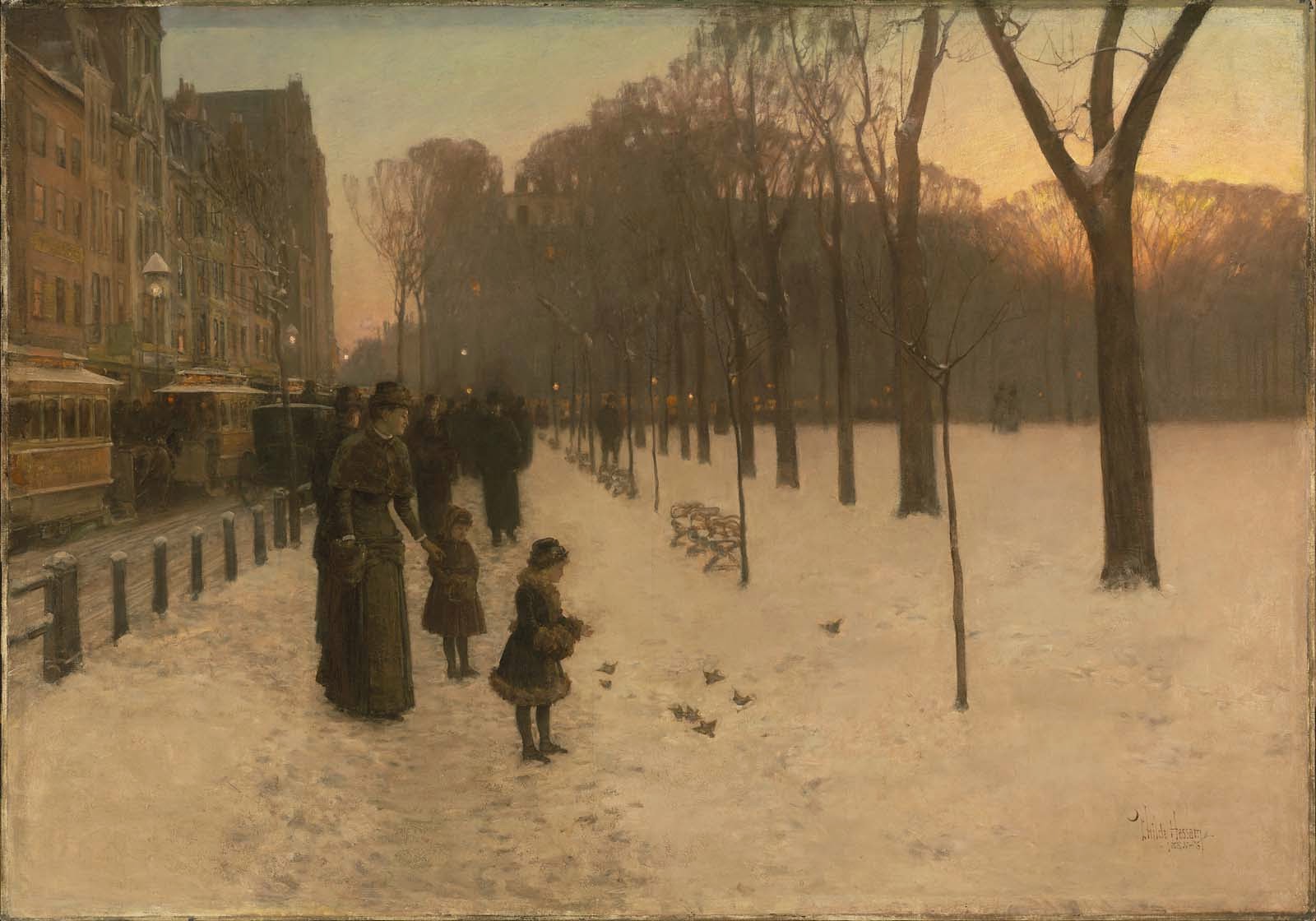
             A famous Childe Hassam painting hangs there.  Children feed  pigeons  off the Commons. It’s winter in the late 19th century  and the   Boston sky holds the same pink light  that shines  softly at three AM  three miles from the site of that famous paining.


            The painting is soothing, familiar.  The same snow, the same light. The same Commons, the children walk down Boylston street, then clogged with trolleys before the green line was built to carry commuters  beneath the Commons.
             Art can be comforting. I find  familiar details in art that echo in  our own lives.  I  cringe, thinking of  the late Robin Williams  from  Dead Poet’s society.

            “We read and write poetry because we are members of the human race. And the human race is filled with passion poetry, beauty, romance, love, these are what we stay alive for. You are here , the powerful play goes on and you may contribute a verse. What will your verse be?”

This is my verse.  Michele’s verse is her medical skill, of course, but also, her art.
We were residents at  Chicago’s Michael Reese Hospital.  Another time, another city.  She is a physician and a quilter.  She and her family  have given me untold  comfort and support  during these queasy,  neoplastic times. A few years ago, she  made me a felt ski cap, a  piebald Jesters’ hat to wear  when the chemo  further attenuated my already   thinning hair.
            It  always brought me joy.   It was a symbol:  Even  in the bleakest moments,  life  holds  color, comfort and love.  It served as a  handy link to the un cancered world.  When I felt like talking about the Big C and Me, I could tell  curious strangers that this was my chemo cap, and that would  lead to long conversations about the precarious nature of life.  Last month, we were attending a Broadway play, and a theater worker announced, over a bullhorn “ All of you may enter,   except for that guy with the red ,yellow and blue hat. I want to talk to him.” This sort of stuff happened daily when I wore the hat. I must say, I didn’t mind the attention.


            The hat  is art in its most basic form: Beautiful.  Comforting. familiar.
            And now, it’s gone,  taken from  a  restaurant coat rack.
            I was heartbroken.
            I have tried to buy a similar hat. They don’t exist.  I shopped for one in Boson where  all  hats must bear   GO BOSOX or HARVARD.
               Michele is working  on a new cap. I will wear it  daily, I will sleep with  it, my  Linus blanket.  We have second chances in life, whether through haberdashery or Chemotherapy.
            I stare out the window.  CNN is on. The snowstorm drives the  Boston News cycle. The governor has declared a snowpocalypse.  What if they close the blood bank, where I undergo my treatments?  I’ll stay  here another day for therapy. There will be chaos , confusion and concern, but, for  now, all that exists is a city of  snow.
Retuning to Woody Allen:
  “I like the rain. It washes memories off the sidewalk of life.”
I like the snow,  it’s a window to the past, to art, to other cities.   Best of all,  it will give me opportunities to wear my new hat.  
I think of the  Naomi Shemer song:
ir bageshem sachah lanu kachah -
hachaim yafim kedai lachem lichyot!
--A city in the rain speaks to us. Life is beautiful, it’s worthwhile to live.

         Shit. I haven’t had an optimistic thought in months. The treatment  must be working.  Maybe it’s the hat. Thanks, Michele.